RAGRAF#
A graph-and-vector knowledge base of code for LLM agents.
Website · Wiki · Docs site · Releases · Discussions · Issues
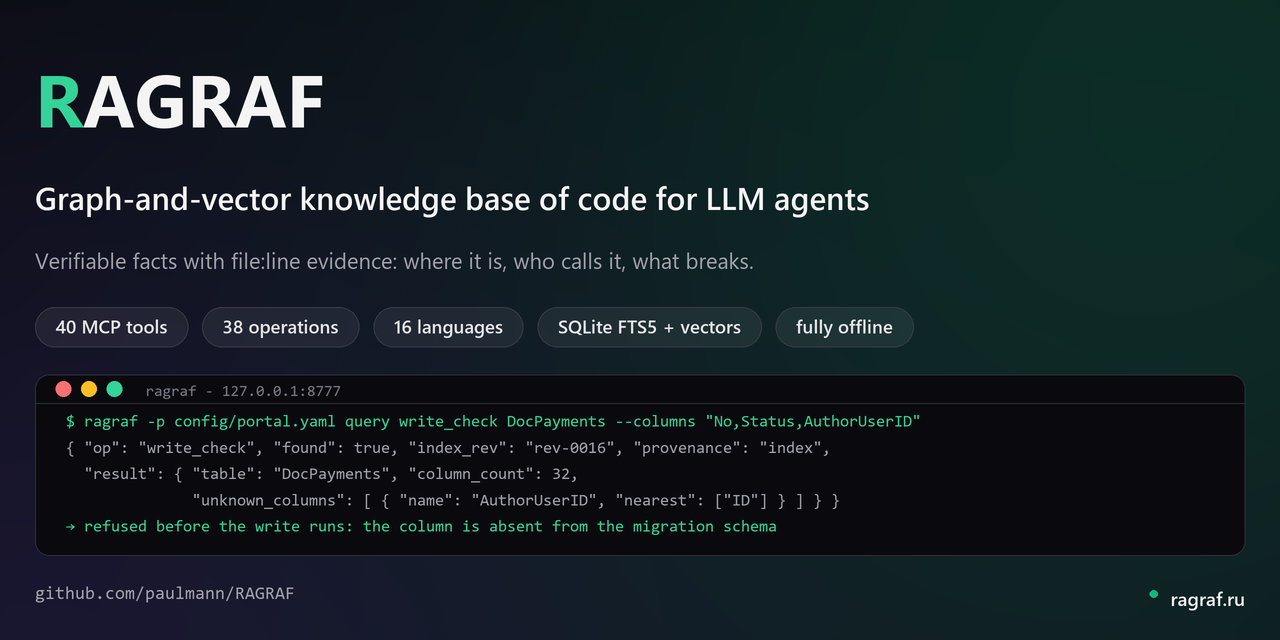
An assistant that answers an agent's questions about a codebase — where is it, who calls it, what breaks if I change it, how is it done elsewhere — with verifiable facts (file:line) instead of blind rg and full-file reads. Python 3.13+, SQLite (graph + FTS5 + vectors in one place), tree-sitter, local embeddings without torch. It runs entirely on the machine that owns the code: no service to run, no cloud index, nothing sent anywhere — a local RAG index over your own repository. An optional property-graph layer (Java + Joern) unlocks slicing; without it the product still works and says so honestly.
Documentation status. Every count in this tree, in
README.ru.md, in the Russian originals underdocs/ru/and in the wiki was re-measured from the sources on 2026-10-16; the summary is in By the numbers, andTest-DocumentedNumbersin the project checker compares those numbers with the code. Documents that describe the release-1 scope keep their own numbers on purpose —docs/architecture/SPECIFICATION.mdstill says 17 operations and states why — while the current surface is 38 operations / 40 MCP tools / 39 CLI query operations.
Contents#
What this is and why#
An agent working on a code change spends most of its context on finding the place: where a function is defined, who calls it, how something similar is done nearby. The usual path is rg plus reading whole files.
RAGRAF replaces that path with an index. The agent asks a question through a fixed operation and gets a fact with a file:line reference — not ten candidates to review.
Measured on a real project (PHP portal, 14 navigation tasks; the run was made on the author's machine — see what the shipped artifacts measure below):
| Metric | Without the index | With the index |
|---|---|---|
| Tool calls for 14 tasks | 28 (realistically 43) | 14 |
| Average per task | 2.0 / 3.1 | 1.0 |
| Candidates to review | up to 34 files | 1–5 exact |
| Files read in full | 14 (minimum) | 0 |
| Target-file hit on the first query | — | 92% (12 of 13) |
Verifiability (facts with file:line) |
— | 100% |
The call, hit-rate and verifiability numbers are measurements of that run; its raw artifacts are not part of the public tree (tracked as R-REL-1 in ROADMAP.md). What does ship is the artifact of the graph metric — bench/results/M2_rev-0012.json and M2_rev-0025.json measure impact-analysis completeness on the same portal: does the graph reach the files that were actually co-changed? Mean recall 0.771 → 0.917 over 20 and 8 commits at depth 3, median recall 1.0, precision 0.072 → 0.020 — deliberately low, because the metric counts connectivity, not prediction — against a naive baseline of 0.0.
«Realistically 43» is a modeled correction (the agent reviews up to 5 candidates instead of one), and it is recorded in the artifact itself.
Re-measured 2026-10-21, with the artifact shipped in the tree. The numbers above describe a run whose raw log is not public, so a new probe answers the same question in a way anyone can repeat: bench/nav_probe.py takes a real corpus (an open-source PHP library, 186 files, rev-0001, capability=full), builds a deterministic sample of 14 names from the source text (function / class declarations — the index takes no part in deciding the right answer), then compares two ways of locating a definition: rg -l over the same tree, and one symbol call.
| Measured 2026-10-21 | Value |
|---|---|
| Names located on the first returned fact | 13 of 14 (93%) |
| Names present anywhere in the single-call answer | 14 of 14 |
Candidate files: rg -l → index |
161 → 42 |
Context to read: rg candidates → answer |
15 178 062 B → 59 872 B (×253) |
| Median answer | 3 ms |
| Reproduce | python bench/nav_probe.py --project config/<corpus>.yaml --limit 14 --out bench/results/nav_probe_<date>.json |
Two honest notes. The single miss is group: four definitions carry that name (three WpCache::$group properties and one function), so the target sits at position 4 — the answer still carries the kind, which rg cannot, so the ambiguity is resolved inside the same call. And this corpus ships mirrored copies (php83/html.php, php85/html.php, src-8.5/), which is why file narrowing is only ×3.8 while byte narrowing is ×253: the same source file is legitimately declared in three places, and the index says so instead of hiding it.
One caveat usually omitted: the 2–3× win applies to localization tasks («where is it defined», «who calls it»). In the edit loop «read → change → verify» there is almost no savings in call count — the win there is different: edits do not corrupt the index, and disputed SQL is checked before it runs.
Use cases#
| You are doing | Ask RAGRAF for | What comes back |
|---|---|---|
| Onboarding an agent onto a 200k-line repository it has never seen | repo_map, then search / symbol |
one fact per question, with file:line, instead of a wall of candidates |
| Refactoring a function that is called from a dozen places | callers, impact, slice when the CPG is available |
proven links separated from heuristics; a slice that says what it actually covers |
| Renaming or dropping a database column | write_check before the SQL runs, then table_usage |
missing columns with nearest-name suggestions; who reads and who writes the table |
| Reviewing someone else's diff | diff, drift_report, live_read |
symbols and edges that changed, regressions included, and the current file marked against the index |
Hunting copies (Files.php … Files7.php) |
duplicates |
which files are copies, and which copy is proven live |
| «How is this done elsewhere in this codebase?» | search (BM25 + vectors, hybrid) |
ranked fragments from the corpus, no model download needed for the answers |
| Wiring the index into an agent | the 40 MCP tools ragraf_*, or the CLI |
the same operations over stdio — see docs/implementation/INTEGRATION.md |
The numbers above are the contract, not marketing: a localization win is measured at 2–3× fewer tool calls, and the edit loop is measured honestly — see What this is and why.
Capabilities#
Thirty-eight operations over a repository — a fixed set, with no graph query language:
| Operation | Answers the question |
|---|---|
search |
where is this written about (hybrid: BM25 lexicon + vector) |
search_multi |
where several strings occur at once; file copies and which one is live |
duplicates |
which files are copies of each other, and what proves the main copy is live |
entrypoints |
entry points: routes, HTTP handlers, CLI, markup endpoints |
dead_code |
files and routines with no references and outside reachability |
symbol |
where is the symbol defined: kind, file, lines, signature |
references |
where else is it used |
callers / callees |
who calls it / what does it call |
impact |
what will a change affect (proven and heuristic links reported separately) |
slice |
structural slice: nodes, edges, lines — without function bodies |
code |
symbol bodies (only on explicit request) |
repo_map |
repository map within a given character budget |
schema / table_usage |
what is in a DB table and who reads or writes it |
routes |
routes and entry points |
policy_trace |
who gets a permission, and under which condition |
class_usage |
a styling class: where defined, where applied, what diverges |
write_check |
is this write valid (write plan checked against the schema before running) |
live_read |
the current file, with differences from the index highlighted |
freshness |
is the index current (checksum comparison) |
index_status |
revision, coverage, degradation, ledger size |
drift_report / drift_ack |
ledger of divergences between index and code |
catalog |
corpus registry: what is indexed and with which checksums |
calibrate |
threshold calibration |
usage |
call telemetry and effect estimation |
diff |
what changed between revisions: files, symbols, edges, regressions |
task_stats |
per-task report: index calls, gate decisions |
gate |
gate decision for a tool call: allow / ask / deny |
note / notes |
record and read a decision note — knowledge between sessions |
The same operations are available as 40 MCP tools (ragraf_*) — to attach to an agent as a server — and through the CLI.
Sixteen languages are parsed as trees (graph nodes and edges): PHP, Python, JavaScript, TypeScript, Java, C#, C, C++, Ruby, Lua, Go, Perl, bash, PowerShell, CSS, HTML — thirteen generic profiles plus dedicated PHP, CSS and HTML extractors. Eleven more are attached as text — files are findable by search but yield no nodes: Markdown, SQL, YAML, JSON, TOML, INI, XML, RST, Rust, batch, plain text. 55 file extensions are mapped in total.
By the numbers#
Every count below was measured on the published tree on 2026-10-16 — not copied from earlier prose. The two that matter most are gated by Test-DocumentedNumbers in tools/Invoke-ProjectDoctrine.ps1, which compares the documents with the code.
| Surface | Count | Measured from |
|---|---|---|
| Facade operations | 38 | def op_* in src/ragraf/facade.py |
| MCP tools | 40 — 6 of them the live-database layer | ragraf_* names in src/ragraf/mcp_server.py |
| MCP resources / prompts | 3 + 1 URI template / 2 | ragraf://status, ragraf://catalog, ragraf://corpus/{name}/map; prompts ragraf-check, ragraf-repair |
CLI subcommands / query operations |
14 / 39 | add_parser(…) and OPS in src/ragraf/cli.py |
| Languages parsed as trees | 16 | TREE_LANGS in src/ragraf/config.py |
| Languages attached as text | 11 | every other language in LANG_BY_EXT |
| File extensions mapped | 55 | LANG_BY_EXT |
| Admin-panel API routes | 32 | src/ragraf/admin_server.py |
| Runtime dependencies | 7 (+1 optional extra, tls) |
pyproject.toml |
Python in src/ |
50 files · 37 592 lines | the published tree |
| PowerShell — installer, wrappers, checker | 5 files · 3 423 lines | the published tree |
| Markdown | 28 files (20 under docs/, 9 of them Russian) + 15 wiki pages |
the published tree and the wiki |
| Portable test suites | 6 suites · 164 checks, 0 failures | each suite run standalone |
| Defect register | 61 findings | docs/DEFECTS.md; the audited revision's summary counts 43 of them by severity |
| Published tree | 136 files · 3.5 MB | the published tree |
Dogfooding, for scale: RAGRAF indexes its own working tree (648 files, 140 741 lines — larger than this published subset) into 3 620 symbols, 46 296 edges and 3 417 chunks in 74 s, 63 s of which is the optional Joern/CPG stage (rev-0156, measured 2026-10-16; capability=full, 0 failed files). Full breakdown: wiki → Benchmarks and Limits.
Measured polygon, anonymised. The registry knows 28 corpora, 25 of them indexed — 10 with the CPG layer, 15 degraded. The 16 whose revision record was read on 2026-10-16 hold 7 527 files, 94 528 symbols, 791 871 edges and 86 790 chunks. Project names, paths and domains are withheld on purpose; the labels are ordered by size, and only the author's private map resolves them.
| Corpus | Kind | Files | Symbols | Edges | Mode |
|---|---|---|---|---|---|
| C-02 | PHP web application | 2 722 | 32 761 | 355 192 | degraded |
| C-04 | C# service / desktop | 1 274 | 20 331 | 98 605 | degraded |
| C-05 | PHP web application | 928 | 17 381 | 99 029 | full |
| C-18 | PowerShell automation toolkit | 81 | 324 | 4 214 | degraded |
| C-24 | Markdown + bash (smallest) | 18 | 184 | 1 515 | degraded |
The full 16-row table, the anonymisation rules and a counting caveat are in the wiki → Benchmarks and Limits. That caveat matters when quoting numbers: the corpus registry and the revision record report different totals for the same revision (measured on one corpus: 8 721 vs 4 498 symbols, 41 201 vs 56 106 edges), so every count above is taken from the revision record — the one the answer envelope reports.
How it works#
Three SQLite stores per corpus, in a .ragraf/ directory inside the indexed project:
| Store | Contents |
|---|---|
graph.sqlite |
nodes (class, function, method), edges (calls, inheritance, imports), DB schema |
lexvec.sqlite |
FTS5 lexicon (BM25) and vectors in one file; raw chunk text for returning fragments |
control.sqlite |
revisions, drift ledger, call telemetry |
Indexing flow: scan (walk + checksums) → ast (tree-sitter: symbols, calls, SQL) → load → resolve (names) → schema (tables from migrations) → cpg (interprocedural calls via Joern) → lexvec (FTS5 + vectors).
Three decisions that define the behavior — each derived from a measured defect:
An immutable index and a ledger of differences instead of «updating on the fly». Within a revision the index does not change; code edits accumulate in the ledger, and affected facts are marked
stale. Otherwise facts from different moments in time would mix in a single answer with no way to tell them apart — which is exactly how wrong conclusions are born.The agent gets no graph query language. Fixed operations only. Rationale: in LLMxCPG (USENIX Security '25) base models produce 132/1278 and 19/1278 valid CPGQL queries versus 1278/1278 for a fine-tuned one — a free-form language turns into an error generator.
Every fact carries proof.
path:line,provenance(stated— proven,derived— heuristic),index_rev,confidence. An edge without evidence looks credible only because it came «from the database».
Degradation instead of failure. A missing code property graph yields capability=degraded and an honest refusal from the slice operation stating the actual mode; all other operations work. No embedding model — lexical search works. No free port — the server reports the reason. Silent degradation never happens.
Installation#
Requires Python 3.13 or newer. No administrator rights needed.
Quick start (one command)#
The bootstrap installer fetches the package from GitHub and deploys it in a dialogue:
iwr -OutFile install.ps1 https://raw.githubusercontent.com/paulmann/RAGRAF/main/install.ps1
pwsh -NoLogo -NoProfile -File .\install.ps1
It asks for the installation directory (default C:\RAGRAF), creates the virtual environment and installs dependencies through scripts/install.ps1, offers to locate AutoClaw and DeepSeek Harness and to set up the connection, and finally prints how to start the admin panel plus a warning about access to it.
It states plainly what it does not do: AutoClaw values are shown, not written — AutoClaw accepts MCP servers only through its own interface, and its store belongs to the product. For Harness the installer can write the profile block, with a backup and a parse check afterwards. An existing installation is never overwritten silently, and a rehearsal run that skips dependencies is available: -SkipDeps.
Windows (PowerShell 7.6+)#
git clone https://github.com/paulmann/RAGRAF.git
cd RAGRAF
pwsh -NoLogo -NoProfile -File scripts/install.ps1
The script creates a virtual environment in ~/.ragraf/venv, installs dependencies, and verifies that the result is a working environment — step by step, ending with a summary table. It does not «pretend to install»: every step ends with a check. A full transcript is written to ~/.ragraf/logs/install-<timestamp>.log, and every external command runs under a timeout.
Useful variants:
# install and immediately prepare a corpus for your project
pwsh -File scripts/install.ps1 -Project C:\work\myproject

# same, plus full indexing (downloads the ~240 MB embedding model)
pwsh -File scripts/install.ps1 -Project C:\work\myproject -Index

# indexing without vectors: no model download, lexical search works
pwsh -File scripts/install.ps1 -Project C:\work\myproject -Index -NoVectors

# in a TLS-inspecting network (corporate proxy)
pwsh -File scripts/install.ps1 -WithTruststore
Other platforms#
One common path, works anywhere with Python 3.13+:
git clone https://github.com/paulmann/RAGRAF.git
cd RAGRAF
python -m venv .venv
. .venv/bin/activate            # Windows: .venv\Scripts\Activate.ps1
pip install -e .                # or: pip install -r requirements.txt
ragraf --version
The product also works without installing the package — via a wrapper that adds src/ to the path itself:
python tools/ragraf.py --version
scripts/install.ps1is verified on Windows (PowerShell 7.6, Python 3.14). The commonpippath on Linux and macOS is not verified — the product was developed and measured on Windows.
External layer: Java and Joern (optional)#
The interprocedural graph (the slice operation) needs JDK 21 and Joern. Without them the product works: the index builds, search and structure are available, and slice refuses with a reason.
# fetch (official GitHub release + Adoptium API), verify SHA-256, unpack, self-check
pwsh -File scripts/install-joern.ps1 -Download

# or verify/prepare from locally placed artifacts (no network)
pwsh -File scripts/install-joern.ps1
Archives go to .tools/downloads/ — the script is idempotent. The unpacked set takes about 5–6 GB.
First steps#
# 1. Prepare the corpus: find it, create it if missing, rebuild a stale index.
#    A corpus for an unknown directory is created by this same command.
ragraf ensure C:\work\myproject

# 2. Check the environment (report on 11 components).
#    NOTE: the command ALWAYS returns exit code 0 — it is not a gate; read the report.
ragraf -p <config> selftest

# 3. Ask
ragraf -p <config> query search "reindex delay"
ragraf -p <config> query symbol --name corpus_hash
ragraf -p <config> query code --name corpus_hash
ragraf -p <config> query callers --name dedupe
ragraf -p <config> query impact --target Facade --depth 2

# 4. Freshness: did the code change after indexing
ragraf -p <config> check
Full command list: ragraf --help. Important: the global flags --project/-p and --json go BEFORE the subcommand (ragraf -p cfg query search ...), while the subcommand's own flags go after it.
Exit codes: 0 — success (including an empty result with found=false), 1 — error, 2 — usage, 3 — the operation cannot run right now (e.g. slice while capability != full).
Corpus management#
ragraf init C:\work\myproject         # create the corpus config and print its path
ragraf -p <config> register           # register the project in the registry
ragraf -p <config> index              # full indexing
ragraf -p <config> reindex            # reindex + archive the drift ledger
ragraf -p <config> drift --scan       # register differences WITHOUT touching the index
ragraf -p <config> status             # state: revision, coverage, ledger size
ragraf -p <config> usage              # telemetry: calls, facts, effect estimate
Attaching to an agent as an MCP server#
{
  "mcpServers": {
    "ragraf": {
      "command": "python",
      "args": [
        "/path/to/RAGRAF/tools/ragraf-mcp.py",
        "--project", "/path/to/RAGRAF/config/mycorpus.yaml",
        "--agent", "my-agent",
        "--agent-kind", "external"
      ]
    }
  }
}
--project is required. --agent and --agent-kind exist only for per-agent call statistics: without them, calls are logged as unknown.
Admin panel#
python tools/ragraf-admin.py --no-browserOpens on 127.0.0.1:8777 and listens on that address only. Shows corpora and their index states, store sizes, index quality, call statistics. Mutating requests require the access token printed at startup.
Requirements and limitations#
| Item | Value |
|---|---|
| Python | 3.13+ (declared in requires-python; verified on 3.14) |
| Platform | Windows + PowerShell 7.6 — verified; other OSes — not verified |
| Privileges | none required: everything runs from the user profile |
| Disk | corpus index .ragraf/ — roughly 1 MB per 1–2 source files; the external Java/Joern layer — ~5–6 GB |
| Internet | needed twice: at install time (PyPI) and at the first indexing with vectors — the ~240 MB embedding model downloads to ~/.ragraf/models |
| Java + Joern | optional; without them capability=degraded and slice is unavailable |
| GPU | optional; accelerates vector encoding only and engages above a break-even threshold |
About the internet and certificates. In a TLS-inspecting network (corporate proxy) the model download fails certificate validation. The cure is truststore:
pip install truststore # or: install.ps1 -WithTruststoreOn a home network the package is unnecessary. Measured: without it — certificate verify failed; with it — 240 MB download in 9.2 s.
About the model cache. The cache directory is overridden by RAGRAF_MODEL_CACHE. Read operations never download the model — only indexing with vectors does.
Documentation#
| Document | Contents |
|---|---|
| ragraf.ru | the public website: features, measured benchmarks, and an emulator of the admin panel |
| Wiki | 15 pages — getting started, operations reference, CLI, MCP, CPG layer, troubleshooting, FAQ |
| Docs site | this documentation set rendered with search (built and deployed by pages.yml) |
docs/architecture/ARCHITECTURE.md |
principles, components, store schemas, operation contracts |
docs/architecture/SPECIFICATION.md |
functional and non-functional requirements, acceptance criteria |
docs/architecture/ACCEPTANCE.md |
measurement protocols M1–M7 and the test map |
docs/implementation/INTEGRATION.md |
attaching to an agent: MCP, working rules, the regimen |
docs/implementation/CPG_INTEGRATION.md |
the code property graph: Joern, JDK, degradation modes |
docs/skills/ragraf-core/SKILL.md |
the skill of working with the index: choosing operations, recovery |
docs/article/RAGRAF_ARTICLE.md |
overview article: stack, architecture, measurements |
docs/DEFECTS.md |
the defect register of the published revision — every finding carries file:line evidence |
ROADMAP.md |
planned improvements and development directions |
CONTRIBUTING.md |
how to report defects and propose changes |
Historical note: the original Russian documentation set is preserved under
docs/ru/in the source repository history. Some internal documents referenced by the deep-dive docs (research notes, effect reports on the author's private corpora) are intentionally not part of the public tree; references to them are marked (not shipped).
Development#
# tests run as standalone scripts — there is no unified runner yet
python tests/test_lang_routing.py
python tests/test_watch.py

# project convention checker (14 checks)
pwsh -NoLogo -NoProfile -File tools/Invoke-ProjectDoctrine.ps1

# refresh the index of RAGRAF itself
python tools/ragraf.py ensure .
The shipped checks are only those that run on synthetic fixtures and are portable. The rest measured behavior on the author's real corpora (a PHP portal, a C# service, their project configs) and would be meaningless on other code.
What passes right after installation:
| Test | Checks |
|---|---|
test_lang_routing.py |
56 |
test_watch.py |
31 |
test_script_extract.py |
25 |
test_threshold.py |
23 |
test_ensure.py |
17 |
test_csharp_records.py |
12 |
Three checks require things the base installation does not include, and that is not a packaging defect but the nature of the check:
test_joern_server.py— needs the external Java + Joern layer (scripts/install-joern.ps1);test_graph_algo.py— needstorch(~2.5 GB), which is in neitherpyproject.tomlnorrequirements.txt: GPU graph algorithms are an optional branch, and withouttorchit honestly degrades to CPU;test_cpg_call_names.py— needs a corpus config (theconfig/directory is not published); you can run the test by copyingexamples/ragraf.example.yamlintoconfig/and pointing it at your own root; without one it refuses to run rather than passing silently.
A tenth file, test_capability_consistency.py, reports «not applicable» until a corpus config exists — it validates the declared capability against what the graph actually contains. test_graph_algo.py without torch still runs 7 checks and names the 17 properties it could not check, rather than printing a green line over untested code.
The project checker is equally explicit about this published subset: of its 14 checks, 11 pass here and 3 report files that are deliberately absent from the public tree (the corpus config, tests/test_dedupe.py, tests/test_text_from_index.py) — tracked as R-REL-1 in ROADMAP.md.
selftest is not a gate: it prints a report on 11 components and always returns exit code 0. A non-zero code is not provided for, so a «green selftest» proves nothing by itself.
Contributing#
Useful reports: a reproducible defect with the command and its output; a document diverging from the code; a case of degradation the product did not name. One thing is welcome above all: a fact with a file-and-line reference. See CONTRIBUTING.md; questions, ideas and measurements on your own corpus go to Discussions. Participation is covered by the Code of Conduct.
The project is developed for concrete tasks, so architecture proposals are discussed more readily than large patches without a prior conversation. Security problems are reported privately, never as a public issue — see SECURITY.md.
If this saved you a context window, a star helps the next agent find it.
License#
PolyForm Noncommercial License 1.0.0 — free for any noncommercial purpose: personal projects, study, research, experiment and testing, and use by charitable, educational, public-research, public-safety, health and environmental organizations. Commercial use needs a separate license from the copyright holder, who keeps every right not expressly granted. CHANGELOG.md records the transition from MIT on 2026-10-15.
GitHub's licence badge for this repository reads «Other»: PolyForm is not in the catalogue GitHub detects, so the badge cannot be trusted here.
LICENSEandpyproject.toml(license = "PolyForm-Noncommercial-1.0.0") are the authoritative sources.
External dependencies keep their own licenses: tree-sitter (MIT), sqlite-vec (MIT/Apache-2.0), fastembed (Apache-2.0), PyYAML (MIT), tiktoken (MIT), ijson (BSD). Java and Joern, installed separately, are distributed under Apache-2.0 and are not part of the distribution.